

Employment Background Check and Investigation
The first step in preventing internal fraud is hiring a candidate whose documents are verified. Know Your Employee verifies each document at its source; for key positions we add expert investigation. The decision is yours; the evidence is ours.
▶ How we verify · 60 secondsNo check runs without candidate consent · no e-Devlet password is requested.
Pre-Hire Risk Indicators
An inconsistency is not always deliberate; but in a key position a small discrepancy can turn into a large cost after hiring. Six indicators; when one appears, the offer letter is held until verification is complete.
Fake or unverifiable diploma
The document is not in the institution's graduation records, or belongs to someone else.
Fabricated or exaggerated work history
Dates, title, scope of authority or reason for leaving do not match the employer's records.
Concealed criminal record
A record directly relevant to the position, not declared on the form or in the interview.
Other 3 risk indicators
Discrepancy in the SGK record
The record shows employers absent from the CV, or unexplained gaps.
Unverifiable contact in the reference check
The named person or organization is not real, or does not know the candidate in that role.
Identity and document inconsistency
The ID, residence, driver’s license, certificate or military-service document do not agree with each other or with the application.
Not every inconsistency is fraud; but every unexplained inconsistency is a question. Four of the six indicators — diploma, SGK, criminal record, identity — are closed by querying the source with Know Your Employee →; work history and references through expert checks.
Our article: Does fraud happen all at once, or are there early warning signs?
Verification is the first checkpoint for employee-driven risks
Fraud is not an exception but a risk that companies face regularly; the door either opens or closes at hiring. The data:
75%+
More than three quarters of employers found an inconsistency in candidate screening in the past 12 months.
64%
64% of fraud cases in Türkiye are committed by employees.
84%
84% of perpetrators show at least one red flag beforehand.
50%
Only 50% of cases are detected within the first year.
Sources: HireRight, 2025 Global Benchmark Report · PwC Türkiye & TEİD, Türkiye Fraud Survey 2026 · ACFE, Occupational Fraud 2026: A Report to the Nations
Every month in a key position enlarges the damage.
A case goes unnoticed for twelve months on average; the loss is US$40,000 when caught in the first six months, and over US$1.1 million beyond five years. Verification takes 1–7 business days before hiring. For allegations that surface after hiring, the second checkpoint: Fraud Investigation →
Personelini Tanı™ Know Your Employee
Four steps, one screen
HR only opens the request and reads the report; obtaining consent, collecting documents and querying the source is the system's job.
Four steps, one screen
01 · HR
Opens the request
02 · Candidate
Consents and uploads
03 · System
Verifies at the source
04 · Expert
Confirms the result
▶ How we verify · 60 seconds
Request a demo → Explore the product →
✓No check runs without candidate consent · no e-Devlet password · sealed report
Priced per credit; no fixed package. For key positions, beyond document verification: expert investigation (the service on this page).
Scope of Verification and Investigation
An interview and a gut feeling are not an adequate control mechanism. There are two paths: for standard positions, the product that verifies each document at its source; for key positions, the expert investigation that looks for the history a document never shows.
Standard positions · Know Your EmployeeDocument verification: queried at the source
- Automated checks — civil registry, residence, diploma/YÖK, SGK service record, criminal record; the verification code is queried with the issuing institution, and name and ID number are compared against the application.
- Expert checks — work-history confirmation, reference check, Findeks; carried out by a Prosecure operator.
- Per credit — you choose the checks in each request; no fixed package. Check list and credits →
Key positions · expert investigationBackground investigation: looks for the undisclosed
- Depth in work history and references — comparison against the SGK record, reason for leaving, structured reference interviews.
- Open-source and shareholding research — social media (LinkedIn, X, Instagram, Facebook), press, trade registry and shareholding records; reputation and conflict-of-interest indicators.
- Global risk screening and executive background check — sanctions lists, PEP, adverse media; for the general manager, finance and procurement directors, authorized signatories, and key personnel ahead of investment. Executive Risk Management →
How does the process work?
01Request and scope
Position, number of candidates and checks: you in the panel, together for key positions.
OutputScope and quote
02Candidate consent
Explicit consent under KVKK; special-category data is approved separately.
OutputConsent record
03Verification and investigation
Documents are queried at the source; work history, references and open sources are investigated.
OutputSource-query records
04Analysis and assessment
Any uncertain check goes to an expert; findings are interpreted according to the position.
OutputRisk-indicator note
05Reporting
Results in a sealed report; on one screen with an executive summary.
OutputCandidate report
Turnaround: 1–7 business days; automated checks are fast, expert investigation depends on scope. Get scope and turnaround for your key position →
Our article: Is background verification a factor in preventing fraud risk?
A Candidate Report That Makes Deciding Easier
The report gives neither a score nor a verdict; it places each check’s source, result and verification code side by side — management makes the decision. It is sealed: with a QR code and verification code, anyone can test its authenticity from a public page.
See the report in the panel — request a demo →
For key-position investigations, an executive risk summary and open-source findings are added: request a quote →
What’s in the report
- Header — requesting organization, masked candidate details, date, number of checks
- Evidential strength of consent — how consent was obtained and with what identity assurance
- Each check individually — check, source, result, verification code, verifier, date
- Overall result and QR — how many checks were verified; the QR code that tests the report
- Key-position add-on — executive summary, open-source findings, risk indicators
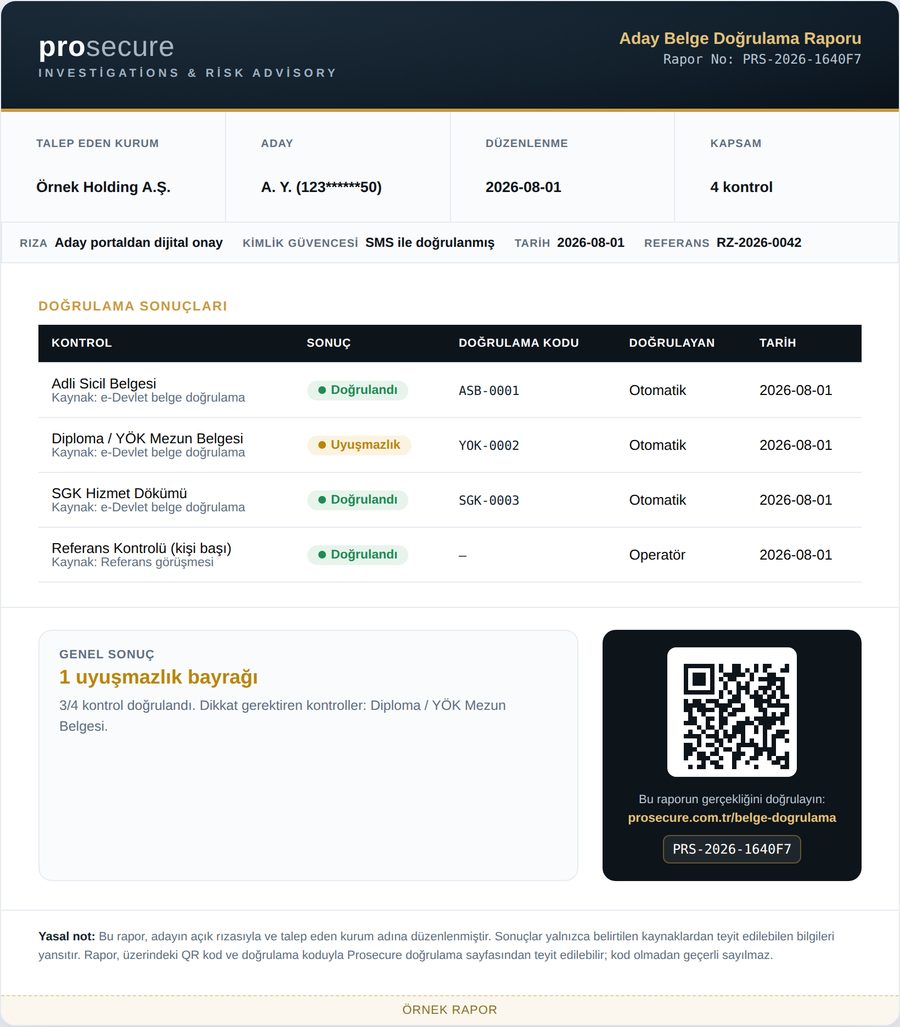

Sample report — Know Your Employee panel output; organization and candidate details are illustrative.
Why Prosecure?
A team that does not just read documents but queries their source; that does not just keep a list but interprets it according to the position's risk. A system for standard positions, an investigator for key positions — under one roof.
Every report is completed under the founder's oversight.
Hasan Alsancak — Former Head of the Financial Crimes and Aggravated Fraud Units, Turkish National Police (1992–2002); FBI National Academy, 205th Session. 30+ years' career, with Prosecure since 2014. He defines the scope with you, assesses critical findings and signs the report.
Document-verification expertise
Documents are queried not from a copy but from the issuing institution via the verification code; a valid barcode is not enough.
Statement–document consistency
The name, ID number and dates on the document are compared against the application; the most common forgery is a genuine document belonging to someone else.
Seeing risks before hiring
Unverifiable documents, missing information and inconsistent statements are reported before the offer letter.
Executive-friendly, sealed report
Critical findings in a one-page summary; each check's source and code in the appendix; authenticity tested from a public page.


Not every inconsistency leads to the same outcome.
The aim of verification is not to eliminate the candidate but to ground the decision in fact.
A finance director candidate's diploma
Situation: a bachelor's diploma on the CV. Finding: the graduation record could not be found at the institution; the candidate had worked with the same document at two previous employers. Decision: the hire was halted; the company also started verification for its key employees.
Review the case → 02 Concealed recordA key-position candidate's criminal record
Situation: the candidate declared no record on the form and in the interview. Finding: a record relevant to the position appeared in the document obtained with consent. Decision: the finding was reported; management decided according to the nature of the risk.
Review the case → 03 Explained inconsistencyTwo employers missing from the SGK record
Situation: two short-term employers in the record that were not on the CV. Finding: in the reference interview the reasons for leaving were explained and matched the statement. Decision: the finding was reported; the candidate was hired.
Review the case →For confidentiality, the examples share no company, sector, person, amount or country details; the events are anonymized and summarized.
Before deciding: Know Your Employee demo → · key position: expert verification → · post-hire allegation: Fraud Investigation →
The first step in preventing internal fraud risk begins with background verification.
Not the last step: it continues with independent investigation when an allegation arises, executive risk assessment for key appointments, and third-party research for business partners.

Fraud Investigation
Examine a report or allegation that surfaces after hiring with confidentiality and impartiality; base the decision on defensible findings.
Explore the service →

Executive Risk Management
Assess person-related risks in key executive appointments; the executive background check is part of this service.
Explore the service →
Third-Party Risk Management
Verify risks related to companies, partners and key individuals before deciding.
Explore the service →To run verification with your own team: Know Your Employee · Measure your fraud risk in ~5 minutes: Fraud Risk Simulator
Frequently Asked Questions
The most common questions about background verification, reference checks and pre-employment investigation.
What Is an Employment Background Check?
Is an Employment Background Check Legal?
Which Documents Can Be Verified?
Are Work Experience and References Checked?
Do You Conduct Open-Source and Social Media Research?
Can Verification Be Done for International Candidates?
What Is the Average Turnaround Time?
What Is Delivered at the End of Verification?
Can I Manage This Process Myself?
What Is the Cost of Not Verifying a CV?
How do we start?
Two paths, one conversation: a Know Your Employee demo for standard positions; expert verification for key positions. Commitment begins only when the scope is approved.
Request a demo → Request a quote for a key position →
The demo is 20 minutes, a live panel with sample data. The first conversation is confidential and creates no obligation; we respond within one business day.
- 1 · Conversation — Positions and annual volume are discussed; which check sits in the panel and which with an expert is clarified.
- 2 · Candidate consent — Explicit consent under KVKK; the candidate brings each document from their own account, no e-Devlet password is requested.
- 3 · Report — Automated checks in the panel; for key positions, an expert report within 1–7 business days; both sealed.