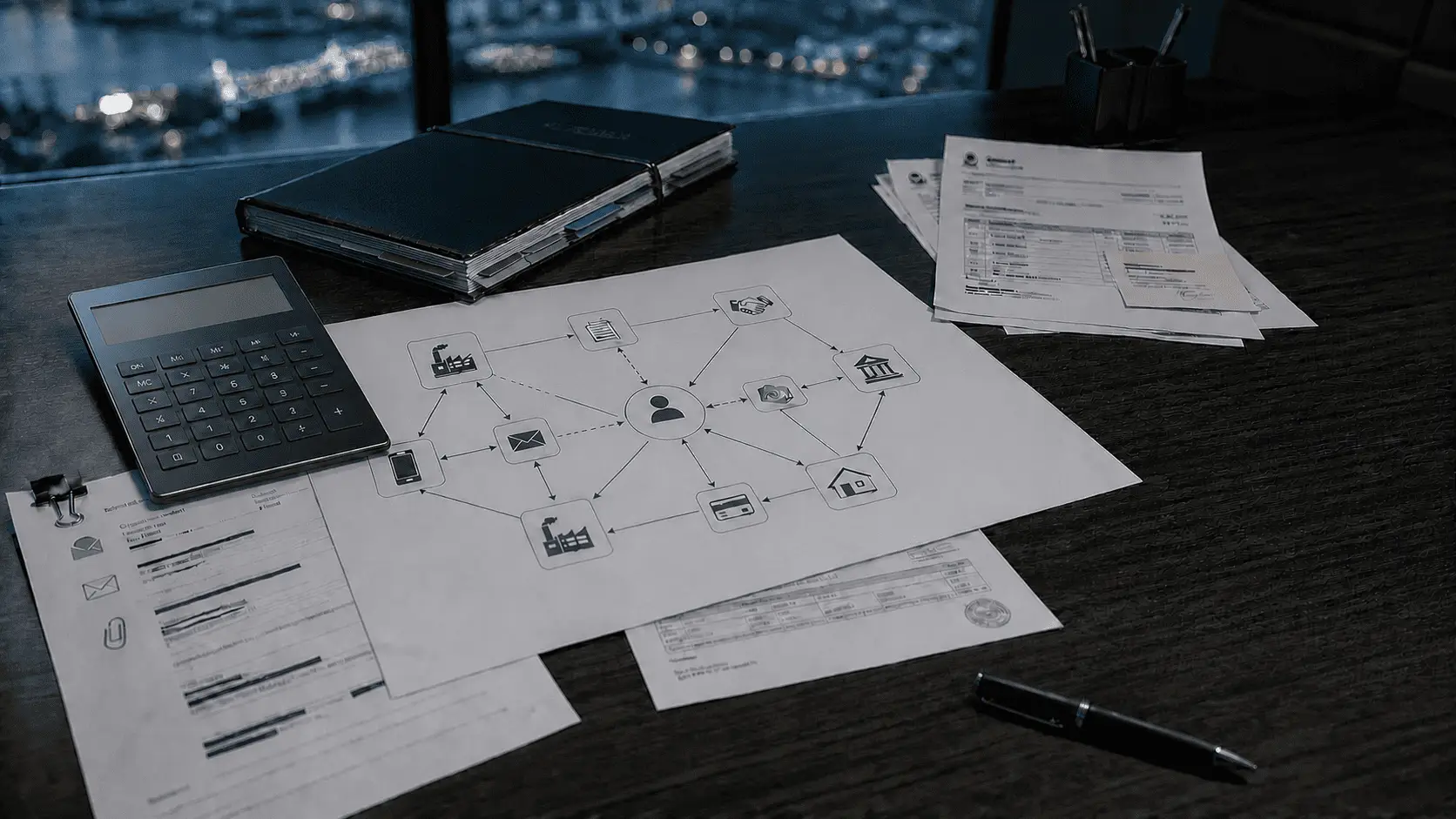
Corporate Intelligence
An investment, a partnership or a hiring decision — beneath every case lies verified information. Corporate intelligence is the analytical discipline that turns scattered, unverified data into a basis you can act on and defend; it underpins all of Prosecure's investigative work.
The initial consultation is confidential.
What is Corporate Intelligence?
Corporate intelligence is the discipline of gathering, verifying and analyzing information — within legal and ethical limits — to support a company's strategic decisions. The goal is not to accumulate data, but to tell which information is reliable, relevant and meaningful for the decision at hand.
01 · SOURCELawful, verifiable sources
Official records, the trade registry, court and enforcement records, open sources (OSINT) and commercial databases.
02 · VERIFICATIONConfirmed, never single-source
Every critical finding is tested against independent sources; unconfirmed information does not enter the report as fact.
03 · ANALYSISA decision-ready assessment
Findings come together in a single, readable risk assessment; management sees what happened and what can be done.
The Difference Between Corporate Intelligence and Espionage
The difference is not how sophisticated the method is, but its legitimacy. Corporate intelligence works from open, lawful and ethical sources; espionage resorts to covert, unauthorized and illegal means. Prosecure does only the former — because a finding obtained unlawfully makes both the decision and the case indefensible.
- Public and lawful sources — registry, official records, open sources.
- A transparent method — the process is documented and traceable.
- Compliance with data-protection law (KVKK) — limits defined from the outset.
- A defensible finding — usable at the decision table and, where needed, in court.
- Covert, unauthorized access — no consent, no basis.
- Illegal methods — wiretapping, data theft, infiltration.
- Legal and criminal liability — it comes back on the company.
- Information with no evidentiary value — it poisons the case and undermines the decision.
A decision made on the wrong information becomes an investigation later.
Most fraud begins with missing information before ill intent: an unverified claim, an unresearched partner, an overlooked connection. The later the risk surfaces, the more expensive it is to undo.
85%
Share of companies that faced at least one fraud or compliance incident in the past two years.
~40%
Share of those incidents where the loss exceeded TRY 5 million.
35%
Share of companies that carry out regular risk and counterparty assessment.
50%
Share of incidents detected only within the first year — half surface later.
Source: PwC Türkiye & TEİD, 2026 Fraud Survey (Türkiye).
Before you research others, measure your own blind spot
The ACFE fraud triangle: Pressure · Opportunity · Rationalization — and Process/Records · Conflict of interest · Compliance and governance; a 0–100 score across six areas.
The first step in assessing others through intelligence is seeing how exposed your own organization is. A 21-question pre-assessment makes the critical indicators visible.
21 questions
A structured assessment
~5 minutes
A quick pre-assessment
Preliminary analysis
A starting point for expert work
✓Aligned with ACFE principles · ~5 minutes · downloadable PDF report
The most expensive information is the kind you learn too late.
The cost of a connection that surfaces after the decision is not one-dimensional: an investment that cannot be recovered and a financial loss; legal liability arising from a relationship with the wrong party; reputational damage from your brand being associated with the wrong name; and the time spent unwinding the case.
That is why the first step is not a large audit but a short, confidential pre-assessment before the decision. Intelligence does not remove risk — it makes it visible in time and in a verifiable way.
When is corporate intelligence needed?
The right question asked before a decision prevents much of the risk that would otherwise follow. Each of the situations below connects directly to a related investigative engagement at Prosecure.
Before a partnership, investment or decision
Independently verifying a party's identity, history and reputation before entering into a relationship.
Related work: Third-Party Risk →Mergers and acquisitions (M&A)
A target company's ownership structure, hidden connections and undisclosed risks — as part of due diligence.
Related work: Due Diligence →Hiring and critical positions
Verifying the declared history and references for senior and sensitive roles.
Related work: Background Verification →Other 3 situations
Suspicion of fraud and internal investigation
Uncovering, on the evidence, the person, method and connections behind an incident.
Related work: Fraud Investigation →Before collection, recovery or litigation
Researching a party's real assets and ability to pay before you act.
Related work: Asset Tracing →International parties and compliance
Sanctions, PEP and adverse-media screening in cross-border relationships; measuring money-laundering risk.
Related work: Sanctions & PEP Screening →If your situation isn't on the list: let's discuss it on a confidential basis →
What does a corporate intelligence engagement cover?
Scope is set by the nature and risk level of the matter; in every engagement, findings come together in a single, readable assessment.
- Identity and legal-entity verification — who the party really is.
- Beneficial ownership (UBO) and ownership network — the names behind it.
- Reputation and adverse-media screening — the public record.
- Compliance checks — sanctions, PEP and watchlist matches.
- Legal and enforcement history — litigation, liens and disputes.
- Financial and solvency signals — the gap between claim and reality.
- Relationship-network and hidden-connection analysis — the unseen bridges.
- Conflict-of-interest and red-flag detection — the critical warnings.
What do we deliver at the end of the engagement?
The scope of the report depends on the nature of the matter; in every case, the aim is for management to see clearly who they will be working with, what the risk is, and what steps can be taken.
The initial consultation is confidential and creates no obligation. If findings are to be taken to court or arbitration: Litigation Support
- An executive summary and a consolidated risk assessment
- An identity, legal-structure and beneficial-ownership (UBO) map
- Compliance findings: sanctions, PEP and watchlist results
- A reputation and adverse-media assessment
- The red flags identified and the reasoning behind them
- The scope of the sources used and the verification method
- Actionable recommendations and monitoring items before the decision

Good corporate intelligence is not having a lot of information; it is being able to tell the right information apart.
Hasan Alsancak
Founder & General Manager
Directorate of Intelligence and Anti-Smuggling & Organized Crime, Turkish National Police (1992–2006, Superintendent) · FBI National Academy, 205th Session · 30+ years · with Prosecure since 2014.
Work that runs on the same discipline
Corporate intelligence is often the first step of an investigative case; as the findings deepen, they turn into the engagements below, run on the same discipline.

Fraud Investigation
Uncovering, on the evidence, the person, method and connections behind an incident; prevention and compliance.
Explore the service →
Third-Party Risk Management
Independent, pre-decision due diligence on partners, suppliers and investment targets; sanctions, PEP and UBO.
Explore the service →
Asset Tracing & Recovery
Researching real assets and ability to pay before collection, recovery or litigation.
Explore the service →Related protection services: Executive Protection · Event Security · also Background Verification · Litigation Support
About corporate intelligence
Basic questions about the scope, sources, legal nature and confidentiality of the engagement.
What is corporate intelligence?
What is the difference between corporate intelligence and espionage?
In which situations is corporate intelligence carried out?
What is researched in an engagement?
Where does the information come from, and is it lawful?
How is confidentiality protected?
What is the deliverable, and how can the findings be used?
What is the cost of not researching?
How do we start?
Three steps: a confidential conversation, a short pre-assessment, and a scope agreed together. Nothing is binding until the scope is approved.
The initial consultation is confidential and creates no obligation. We respond within one business day.
- 1 · A confidential first conversation — We listen to which party you're dealing with, the decision you need to make, and how urgent it is.
- 2 · Pre-assessment and scope — The risk level of the matter is assessed; a scope and timeline are proposed.
- 3 · Research and report — Sources are screened, critical findings are confirmed; a risk assessment and recommendations are reported.