

Litigation Support and Dispute Investigations
What decides a matter is not being right, but being able to prove it: we develop the parties’ connections, the chronology of events, and asset indicators — through a team formed in financial crime investigation — in a form your counsel can put straight into the record.
The initial consultation is confidential.
Critical cases begin with clear research questions.
Every matter has its own scope. The work is built around the requirements of the proceeding and the specific question that needs an answer — it starts from what must be proven, not from what happens to be findable.
Commercial disputes
When the counterparty’s operations, corporate affiliations, and the commercial background of the dispute are missing from the record.
Fraud and misconduct allegations
When the allegation, the links between events, and the individuals or entities involved call for independent investigation.
Partnership and shareholder disputes
When relationships among shareholders, officers, and affiliated companies — and undisclosed interests — need to be established.
Other 3 case types
Debt and asset recovery
When the counterparty’s economic footprint, asset indicators, and related entities determine whether a claim is collectible.
Arbitration and cross-border matters
When companies, individuals, and commercial relationships spanning multiple jurisdictions bear on recognition and enforcement of an award.
Complex relationship networks
When connections across numerous people, companies, transactions, and events must become a structure a tribunal can follow.
If your matter falls under one of these headings: let’s define the research questions together, in confidence →
Evidence does not improve with waiting; it degrades
Disputes are rarely lost for want of a legal theory. They are lost because the proof that theory depends on was never developed in time.
Starting late carries financial, legal, reputational, and time costs at once: an unprovable claim becomes a loss, and a case filed on incomplete proof becomes a dead end on the merits. With every passing month, records are overwritten, commercial relationships are wound down, assets change hands, and the detail witnesses recall grows thin. That is why the first step is not a complaint but a short, confidential case review.
A judgment you win counts only if you can collect it
In most matters the dispute investigation runs alongside the asset question: can the counterparty pay, where did the assets go, and which structure stands behind them? Both strands proceed with the same team, as one file.
Pre-filing
Asset position for prejudgment attachment and injunctive relief
During the case
Fraudulent transfers and concealment structures identified
Post-judgment
A traceable asset map for enforcement and collection
If the dispute grew out of misconduct, the work starts with what happened and who did it: it runs together with Fraud Investigation.
74%
Of victim organizations that pursued civil action, this share resolved in a settlement or a judgment in their favor — where the findings exist, the process works.
ACFE, Report to the Nations 2024
12 months
Median time a scheme runs before it is detected; that is how old the evidence already is when the case is opened.
ACFE, Occupational Fraud 2026
$1.1M
Median loss in schemes lasting more than five years; in those caught within the first six months, the same figure stays at $40,000.
ACFE, Occupational Fraud 2026
~40%
Of incidents in Türkiye carry a financial impact of TRY 5 million or more — the scale at which these disputes begin.
PwC Türkiye & TEİD, 2026
What can our research reveal?
We do not assess information item by item, but together with the connections among people, companies, economic activity, and events. The scope is confined to lawful, verifiable sources.
Individual and corporate connections
The commercial and corporate ties the parties hold with one another and with third parties.
Direct and indirect ownership
Ownership chains, subsidiaries, and the structures standing behind apparent title.
Related parties and decision-makers
Separating the nominal representative from the actual decision-maker; identifying related-party transactions.
Other 3 areas we examine
Asset indicators
The counterparty’s economic footprint and the recorded asset traces that speak to collectability.
Event and transaction chronology
Placing critical events, corporate changes, and transactions in date order.
International commercial connections
Companies, individuals, and commercial relationships across jurisdictions, traced through public records.
On why a perpetrator rarely acts alone — our article: Is fraud an individual act, or a team effort? →
Our litigation support process
Each phase runs inside a controlled, traceable structure built around the research questions. Every step produces a concrete work product counsel can take forward.
01Case review
The subject of the dispute, the parties, and the core questions are established; what must be proven becomes explicit.
OutputResearch questions
02Research plan
Hypotheses, sources, jurisdictions, and the limits of the engagement are set; the boundary of lawfulness is drawn at the outset.
OutputScope and source plan
03Research and verification
Open sources, corporate registries, and lawful information sources are searched; every finding is corroborated.
OutputSource matrix
04Connections and chronology
Relationships among people, companies, events, and transactions are analyzed and rendered into a structure that can be argued.
OutputRelationship map
05Reporting
Findings are delivered with source references in a single file counsel can use directly.
OutputLitigation support file
On how a finding is tested — our article: Why is cross-examination still critical? →
Outputs provided to the legal team
Not raw information, but work product that is connected, sourced, and ready for the record. Scope varies with the matter; format follows the way your team works.
Research report
Findings, sources, and critical assessments set out in a clear, traceable structure.
Relationship map
Relationships among people, companies, and connected entities made visible at a glance.
Event chronology
A timeline of critical events and corporate changes in date order.
Other 3 outputs
Source matrix
Which source each finding rests on, and its verification status, itemized.
Executive summary
A concise summary of the core findings and conclusions for the decision-maker.
Scope and limitations note
What was researched and, just as important, what could not be — separating assumption from verified finding.
We shape the deliverable around your matter: let’s discuss what you need, in confidence →
Investigative by origin. Defensible findings.
Prosecure does not practice law. We provide research and analysis support to outside counsel and in-house legal teams. In a complex matter, placing information in the right context matters as much as obtaining it.
Every matter is run by the founder.
Hasan Alsancak — Former Head of the Financial Crimes and Aggravated Fraud Units, Turkish National Police (1992–2003) · FBI National Academy, 205th Session · 30+ years’ career, with Prosecure since 2014. He sets the research questions with counsel, leads the work, and signs the report.
Case information and findings are shared only with authorized individuals; confidentiality governs the engagement throughout.


Not every matter reaches the same outcome.
The purpose of the work is not to wear the other side down; it is to put the legal strategy on verifiable ground and to show the real limits of the matter from the outset.
Two seemingly unrelated companies were documented as answering to the same decision-maker
Commercial registry filings, signature authorities, and trading records were reviewed together. The shared management link between the contracting counterparty and the losing bidder was established; the relationship map and source matrix went into the record.
Review the case → 02 Chronology turned the caseIn a shareholder dispute, the sequence of key decisions reversed the allegation
Corporate changes, delegations of authority, and transaction dates were consolidated into a single timeline. The order of filings contradicted the counterparty’s “we learned of it later” position and was submitted in the arbitration.
Review the case → 03 Limited result — scope narrowedIn a cross-border matter, accessible sources proved limited and the scope was reset
Records in the target jurisdiction are closed to the public, so the expected connection could not be corroborated. What could not be researched was reported plainly; counsel redirected resources to the structure in a second jurisdiction where results were achievable.
Review the case →For confidentiality, no company, sector, individual, amount, or country is identified in these examples; the matters have been anonymized and summarized.
If you have a comparable matter: let’s discuss it in confidence →
A dispute rarely arrives alone.
A matter often surfaces the source of the loss, the counterparty’s asset position, or a business partner’s history. These engagements run on the same investigative discipline, each completing the other.

Asset Tracing & Recovery
Connects the judgment to collection: traces assets before and after filing, along with true ownership and concealment structures.
Explore the service →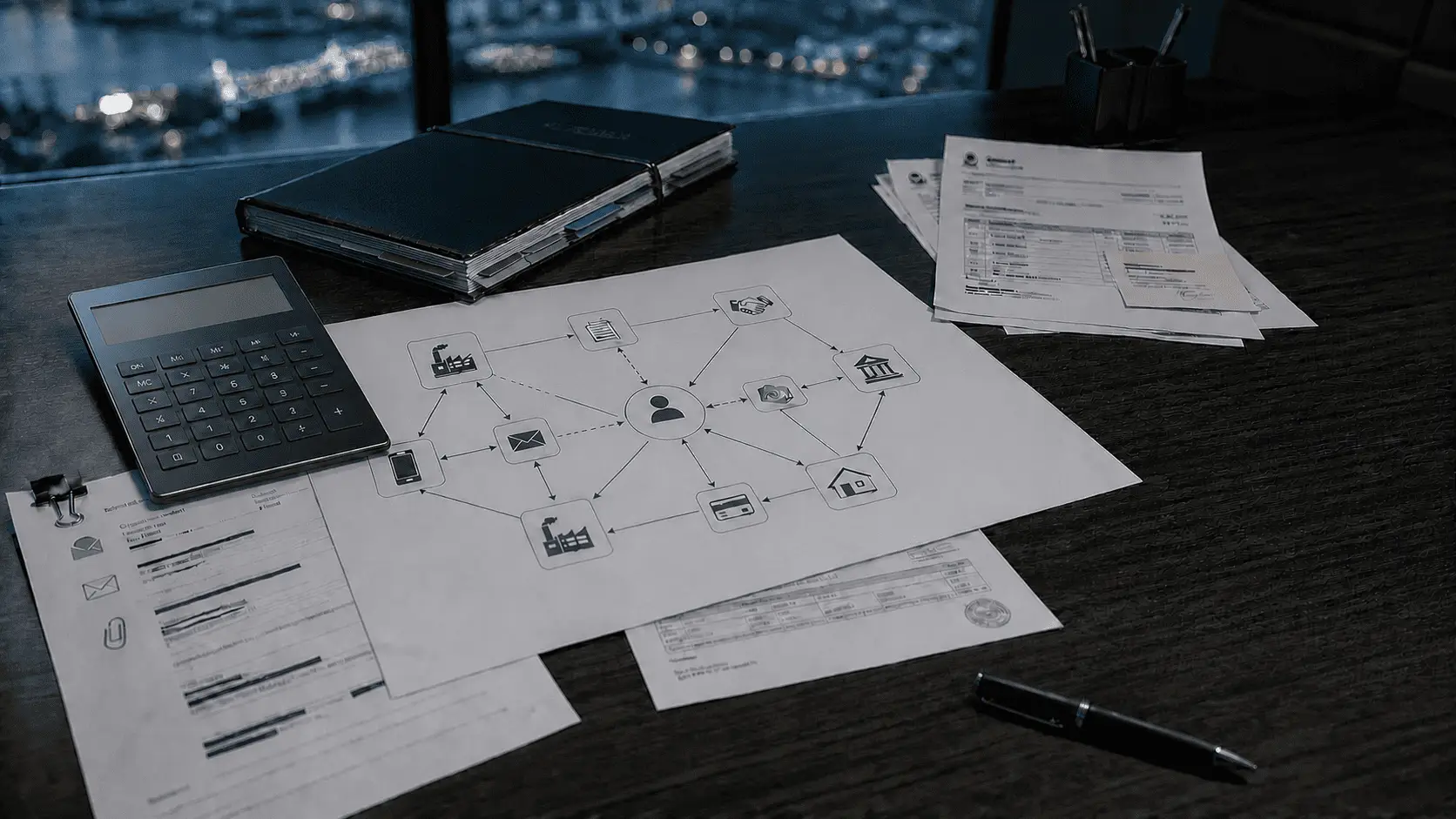
Fraud Investigation
Finds the source of the loss: examines employee, executive, or partner misconduct in confidence — often where the matter begins.
Explore the service →
Third Party Risk Management
Prevents the next dispute: verifies a partner’s or supplier’s ultimate beneficial owner before the contract is signed.
Explore the service →In-depth research before a decision: Corporate Intelligence · Risk in hiring: Employment Background Check · Know Your Employee™
Measure your own organization’s fraud risk: Fraud Risk Simulator™ · About Prosecure: About Us · Founder
What you might want to know before starting
Core questions on the scope of the work, its legal character, timing, and our approach to confidentiality.
What is litigation support and dispute investigation?
Does Prosecure provide legal advice?
Is the same research carried out for every case?
Can international research be conducted?
Can the findings be used in legal proceedings?
How long does the research take?
What does it cost to postpone the research?
How do we start?
Three steps: a confidential conversation, a short case review, and a scope agreed together. Nothing is binding until that scope is approved.
The initial consultation is confidential and creates no obligation; we respond within one business day.
- 1 · Confidential first conversation — We listen to the subject of the dispute, the parties, and any hearing schedule; we clarify the questions you need answered.
- 2 · Case review and scope — We assess which questions can be answered from which sources, then propose scope, jurisdictions, and an estimated timeline.
- 3 · Research and report — Sources are searched and findings corroborated; the file is delivered with a relationship map, chronology, and source matrix.